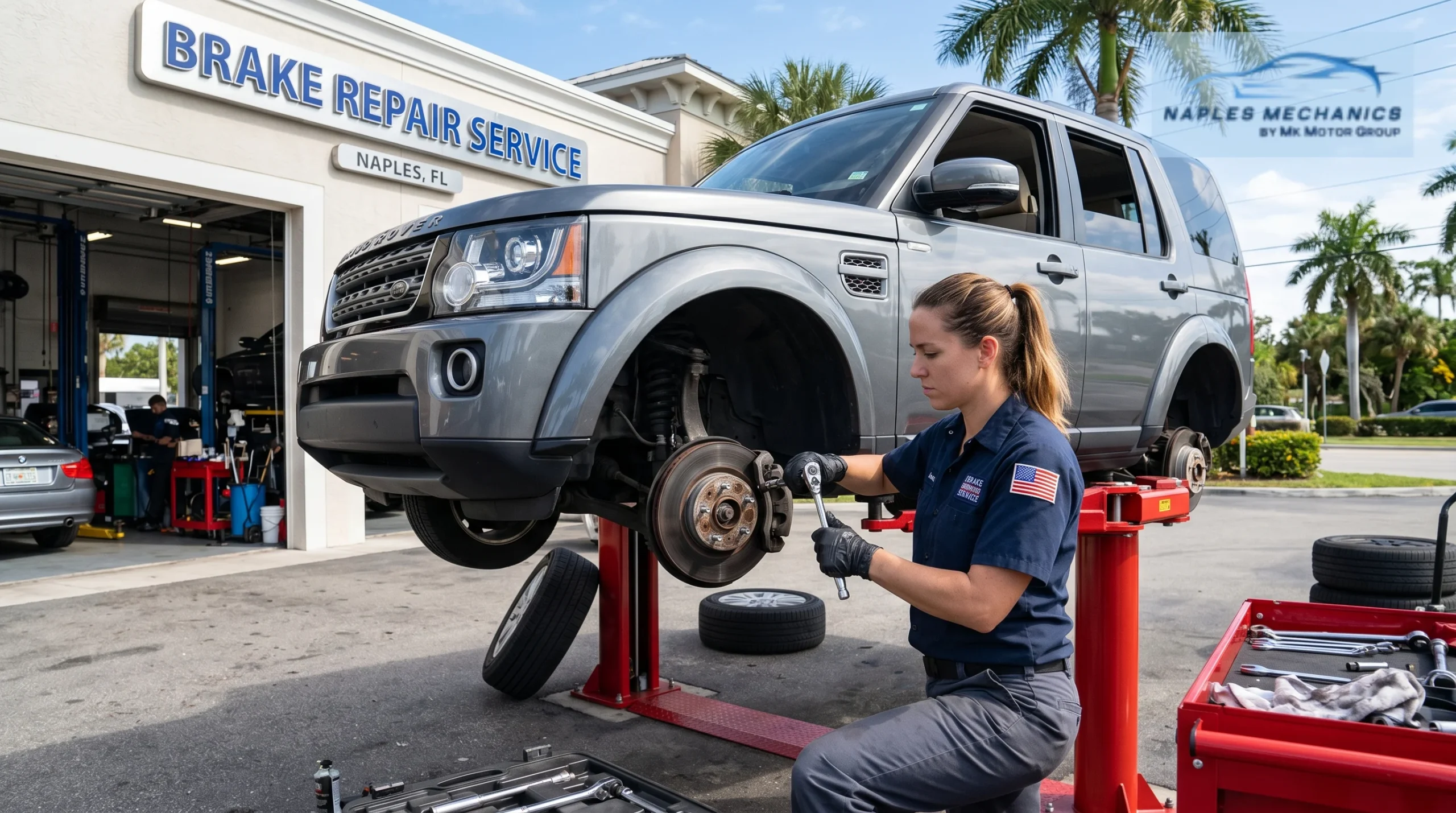
Brake problems rarely show up at a convenient time. A squeal pulling out of your driveway, a shudder in the steering wheel when you stop at a US-41 light, or a pedal that suddenly feels soft underfoot are all your car telling you something. Southwest Florida driving puts real stress on a braking system: the heat, the salt-heavy coastal air, and the constant stop-and-go all wear parts faster than a driver in a drier climate would expect. Knowing when to book a brake repair service in Naples lets you catch a small problem while it is still small, and before it turns into a safety issue or a much bigger bill.
This guide covers the warning signs worth watching, what a proper brake job involves, how the technicians at Naples Mechanics diagnose the cause instead of guessing, and the honest factors behind the price. If you already know something is wrong, you can skip ahead and call us at 239-399-0928 or book an appointment online.
Why Brake Maintenance Matters for Naples Drivers
Brakes work by turning your car’s momentum into heat, and Naples does not make that easy. Summer afternoons routinely sit in the low to mid-90s, so rotors and pads start their job already warm. Add a few hard stops in traffic and components run hotter than they would up north, which speeds up pad wear and can cook old brake fluid past its useful life.
Then there is the salt. Living near the Gulf means humid, salt-laden air that corrodes metal hardware over time. Caliper slide pins, mounting clips, brake lines, and the parking-brake mechanism are all vulnerable. A seized slide pin from corrosion is one of the most common causes of uneven wear we see on coastal vehicles, and it often shows up long before the pads themselves are gone.
Traffic patterns add to it. From late fall through spring, seasonal residents and visitors fill up roads like Tamiami Trail, Airport-Pulling, and Pine Ridge, and that stop-and-go means more brake applications per mile. A car doing daily errands around East Naples, Golden Gate, or North Naples will wear through pads faster than the odometer alone suggests. None of this is cause for alarm. It just means Naples brakes earn their inspections, and the drivers who stay ahead of wear tend to spend less over the life of the car.
Common Signs Your Vehicle Needs Brake Repair
Your car usually warns you well before brakes fail outright. Here is how to read the signals.
Squeaking or grinding sounds
Most brake pads are built with a small metal wear indicator. When the friction material wears down to the last few millimeters, that tab starts contacting the rotor and produces a high-pitched squeal, often loudest at low speed or first thing in the morning. That squeal is doing its job: it is telling you the pads are near the end.
Grinding is a different and more urgent sound. A harsh, metallic grind usually means the friction material is gone and the metal backing plate is now dragging on the rotor. At that point you are scoring the rotor with every stop, which turns a routine brake pad replacement into a pad-and-rotor job. If you hear grinding, treat it as a now problem, not a next-week problem.
Changes in the brake pedal
How the pedal feels tells you a lot about the hydraulic side of the system. A pedal that sinks too far or feels spongy can point to air in the lines, a fluid leak, or moisture-contaminated brake fluid that boils under heat. A pulsing or vibrating pedal during braking usually traces back to uneven rotor thickness or runout, sometimes described loosely as a warped rotor. And a brake that simply takes more effort or more distance to stop than it used to is worth getting looked at, even if nothing else seems wrong.
The vehicle pulls to one side while braking
If the car drifts left or right when you brake, the two sides are not gripping evenly. The usual causes are a sticking caliper, uneven pad wear from a seized slide pin, or a hydraulic issue such as a collapsed flexible brake hose restricting flow to one wheel. A pull is rarely worth ignoring, because it means braking force is unbalanced exactly when you need it to be even.
Warning lights on the dash
Two different lights matter here. The brake system warning light can mean low fluid, a parking brake left engaged, or a hydraulic problem. The ABS light points specifically to the anti-lock braking system, often a wheel-speed sensor or module fault. Either light is a reason to have the brakes scanned, since the cause is not something a visual check alone will always reveal.
Hearing or feeling any of these in Naples? Don’t wait for the grind. Call Naples Mechanics at 239-399-0928 or request a brake inspection. Most standard brake jobs are completed the same day.
What Does a Brake Repair Service in Naples Include?
Brake repair is the work of restoring safe stopping performance by inspecting, servicing, or replacing the components that wear out: pads, rotors, calipers, hardware, fluid, and the hydraulic lines that connect them. A thorough visit moves through a few stages.
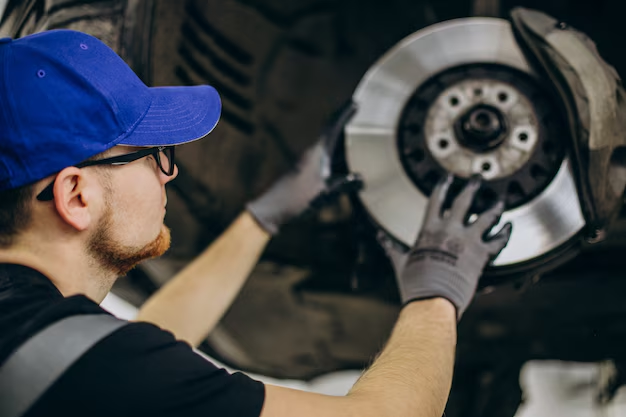
It starts with a brake inspection. A technician pulls the wheels and inspects the entire system: pad thickness, rotor surface, calipers, hoses, hardware, and the parking brake. Measurement matters here. We do not eyeball it; we use a gauge or micrometer so the recommendation rests on numbers, not guesswork.
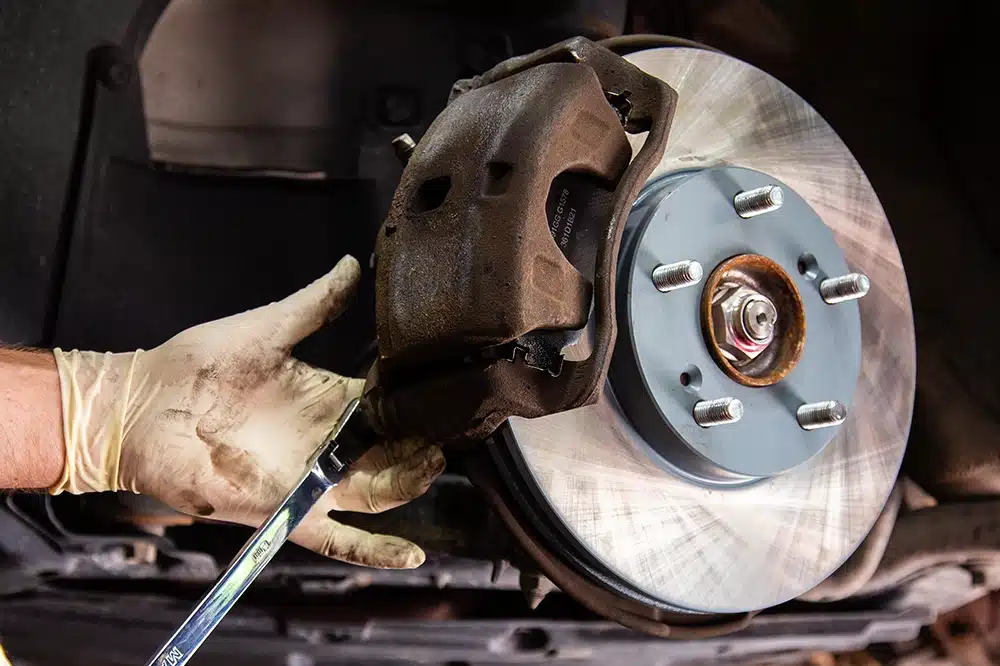
If the pads are worn, the next step is to replace the brake pads. The old pads come off, new friction material goes on, and the hardware and slide pins are cleaned and lubricated so the new pads sit and move correctly. Skipping that hardware step is a common shortcut that leads to noise and uneven wear down the road. Pad choice matters too: ceramic pads run quieter and cleaner, while semi-metallic pads handle heat well, and the right one depends on the vehicle and how it is driven.
Rotors are evaluated on their own. A rotor that is smooth and still above its minimum thickness can sometimes stay in service or be resurfaced. A rotor that is scored, below spec, or has uneven thickness needs brake rotor replacement. Resurfacing only makes sense when there is enough material left to safely remove some, which is why measurement comes first.
The hydraulic side gets attention as well. That means a brake fluid check for moisture and contamination, since fluid absorbs water from the air over time and that lowers its boiling point. In hot, humid Naples, fluid that boils under hard braking causes a soft pedal and brake fade, so a fluid exchange is part of the job when it is due. Brake lines and hoses are inspected for corrosion or leaks, and the master cylinder and calipers are checked for proper operation. Vehicles with rear drum brakes get a drum service, and cars with anti-lock brakes get an ABS scan when a warning light is present.
How Our Technicians Diagnose Brake Problems
A good diagnosis is what separates real repair from parts swapping. The point is to find the cause, not just quell the symptom.
At Naples Mechanics, the process starts with a physical inspection of every component, then a rotor thickness measurement against the manufacturer’s minimum spec stamped on the part. We evaluate the brake fluid for moisture and contamination, since degraded fluid affects the whole hydraulic system. We check caliper operation, confirming the pistons and slide pins move freely rather than sticking, because a lazy caliper produces both uneven wear and pulling. On vehicles with anti-lock brakes, we read ABS codes with professional scan tools, including Snap-On Modis, Autel, and AutoLogic, which helps pinpoint sensor or module faults a visual check would miss.
That sequence is why two cars with the same squeal can leave with two different repairs. One might need pads. The other might need a caliper freed up and the fluid flushed. We service European, Asian, and domestic vehicles, from BMW, Mercedes-Benz, and Audi to Toyota, Honda, and Lexus to Ford, Chevrolet, and Jeep, and the diagnostic approach is the same across all of them: measure, confirm, then recommend.
How Much Does Brake Repair Service in Naples Cost?
There is no honest single number for brake repair, and any shop quoting a flat price before looking at the car is guessing. The cost depends on what the vehicle actually needs and what kind of vehicle it is. The main factors are:
- The make and model, since parts for a European or performance car cost more than parts for a common sedan
- Whether the work is pads only, pads and rotors, or extends to calipers, hoses, or hydraulic repairs
- The grade of parts chosen, since the pad and rotor quality vary
- How many corners need work, since front and rear brakes are priced separately
- Labor complexity, because some vehicles take longer to service than others
Put simply, brake repair costs vary depending on whether your vehicle needs brake pad replacement, rotor service, caliper repair, or additional hydraulic work. The value of a proper inspection is that it tells you exactly which of those you are paying for, and which you are not. We give you an itemized estimate before any work begins, so you can see the difference between what is necessary now and what can reasonably wait, and we use factory or OEM parts where we can to keep the repair lasting longer.
Can You Drive With Bad Brakes?
You can, right up until you cannot, and that is the danger. Worn brakes do not fail politely. Driving on pads that are gone means metal grinding on metal, which ruins rotors and lengthens your stopping distance at the worst possible moment. A soft pedal from contaminated fluid can fade to almost nothing on a long stop or after repeated hard braking. A sticking caliper can overheat, and the affected wheel may keep dragging even after you lift off the pedal.
There is a cost angle, too. The driver who ignores a squeal often pays for rotors that a timely pad replacement would have saved. Catching the problem at the inspection stage is almost always cheaper than catching it at the grinding stage, and far cheaper than catching it during a near-miss. If you suspect a brake problem, the safe move is to have it looked at before your next long drive.
Brake Repair vs Brake Replacement: What Is the Difference?
Brake repair means servicing or correcting a specific issue without changing the major components: cleaning and lubricating seized hardware, freeing a sticking caliper, bleeding air from the lines, or flushing tired fluid. The core parts are still serviceable, and something just needs to be put right.
Brake replacement means worn or damaged parts come out and new parts go in: pad replacement, rotor replacement, a new caliper, or a new brake hose. Most real-world brake jobs are a mix of the two, which is why the inspection matters so much. It draws the line between what can be repaired and what has reached the end of its service life.
How Often Should You Get Your Brakes Checked?
Have your brakes inspected at least once a year, and during routine service such as tire rotations, since the wheels are already off. There is no universal mileage that fits every driver, because wear depends on how and where you drive. A car living in Naples stop-and-go traffic goes through brakes faster than a highway commuter, and heavier vehicles, aggressive braking, and frequent short trips all shorten pad life. Always check your owner’s manual for the manufacturer’s recommended intervals, and treat any new noise, vibration, or change in pedal feel as a reason to get an inspection sooner. Catching wear on a calendar is cheaper than catching it on the road. Pairing a brake check with your regular vehicle maintenance is the easiest way to stay ahead of it.
Brake Repair Service in Naples and Southwest Florida
Our workshop sits at 3784 Domestic Ave, Ste F, in Naples, just off Airport-Pulling Road near the I-75 interchange, which keeps us central to most of Collier County. We handle Brake Repair Service in Naples and the surrounding communities, including East Naples, North Naples, Golden Gate, Pelican Bay, and the coastal neighborhoods that see the heaviest salt exposure.
Why Naples Drivers Choose Naples Mechanics
Brakes are not the place to gamble on the cheapest quote or the fastest turnaround. The quality of the work depends on the quality of the diagnosis behind it, so look for a provider that measures components and explains its findings before recommending replacement, rather than selling a full brake job sight unseen.
That is the standard we hold ourselves to. We inspect and measure before we recommend, use factory or OEM parts where possible, and back every repair with a 12-month / 12,000-mile warranty, which is our way of saying we expect to get it right the first time. Our technicians run professional diagnostic equipment and service European, Asian, and domestic vehicles alike, so the same careful approach applies whether you drive a Porsche or a Pilot. When you want the full picture of what we do, the services page lists everything.
Frequently Asked Questions
How do I know my brake pads need replacing?
The clearest early sign is a steady high-pitched squeal from the wear indicator, often loudest at low speed or first thing in the morning. A grinding noise means the pads are already gone, and metal is contacting the rotor, which is more urgent. A measured inspection gives you the exact pad thickness, so you are not guessing.
How long does brake repair usually take?
A standard pad and rotor service on one axle is often completed the same day, sometimes within a couple of hours once the car is in the bay. The timeline stretches if the work includes calipers, a fluid flush, ABS diagnostics, or hard-to-source parts for a specific make and model. We give you a realistic time estimate after the inspection.
What causes brake vibration?
A vibration or pulsing felt through the pedal or steering wheel during braking usually comes from uneven rotor thickness or runout. It can develop from heat, normal wear, or a rotor that was scored by worn-out pads. The fix depends on whether the rotor still has enough material to resurface or needs replacing.
Are brake noises always a problem?
Not always. A light film of surface rust can make brakes squeak briefly after a car sits in humid Naples weather overnight, and that often clears within the first few stops. A persistent noise, gets louder, or turns into a grind is the kind worth having checked. When in doubt, an inspection settles it quickly.
Should I replace brake pads and rotors together?
Often, but not as a blanket rule. New pads seat best against a smooth rotor surface, so if the rotors are scored, below their minimum thickness, or uneven, replacing both lasts longer and runs quieter. If the rotors are still within spec and in good shape, new pads alone can be the right call. Measurement is what makes that an informed decision rather than an upsell.
Where can I get brake repair near me in Naples?
Naples Mechanics is located at 3784 Domestic Ave, Ste F, Naples, FL 34104, just off Airport-Pulling Road, and serves Naples, Bonita Springs, Marco Island, Estero, and Fort Myers. Call 239-399-0928 or book online to schedule a Brake Repair Service in Naples.
Do you offer a warranty on brake repairs?
Yes. Every repair we perform is covered by a 12-month / 12,000-mile warranty, and we use factory or OEM components wherever possible so the work holds up in Southwest Florida’s heat and humidity.